
Two of the most commonly compared varieties when learning Spanish are Peruvian Spanish vs. Mexican Spanish. They’re both clear, widely understood, and great for learners — but they’re not identical. So… what’s the real difference? Let’s break it down 👇
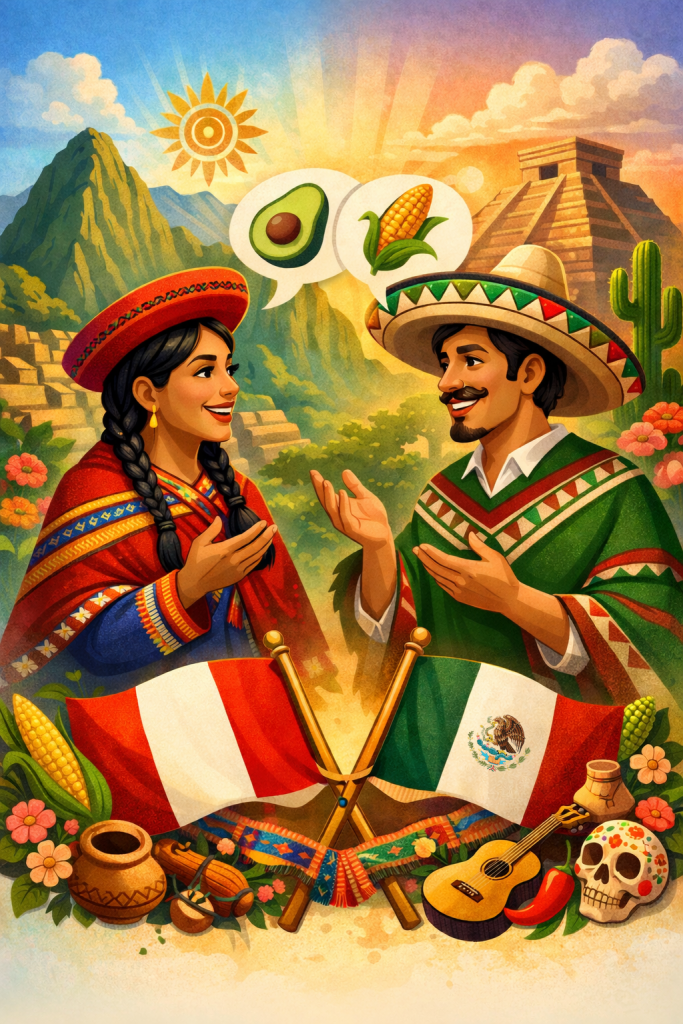
¿Palta o aguacate?: Indigenous language influence
One of the key differences between Peruvian Spanish vs. Mexican Spanish lies in the indigenous languages that influenced them.
- Peruvian Spanish has a strong influence from Quechua, especially in vocabulary, intonation, and expressions related to daily life.
- Mexican Spanish is deeply influenced by Nahuatl, particularly in terms related to food, nature, and cultural concepts.
These influences are not “add-ons” — they are central to how Spanish is spoken in both countries.
📚 Comparative vocabulary: Quechua vs. Nahuatl influence
| English | Peru 🇵🇪 | Mexico 🇲🇽 | Origin & explanation |
|---|---|---|---|
| Avocado | palta | aguacate | Palta comes from Quechua; aguacate from Nahuatl āhuacatl. |
| Popcorn | cancha | palomitas | Cancha (Quechua) refers to toasted corn; palomitas is a Spanish metaphor. |
| Chili pepper | ají | chile | Ají is Quechua; chile comes from Nahuatl chīlli. |
| Corn | choclo | elote | Choclo (Quechua); elote (Nahuatl elotl). |
| Sweet potato | camote | camote | From Nahuatl camotli; more frequent in Mexico but used in Peru. |
| Squash | zapallo | calabaza | Zapallo has Quechua roots; calabaza comes from Spanish/Arabic influence. |
| Turkey | pavo | guajolote | From Nahuatl cacahuatl; used in both, but Mexico preserves the indigenous pronunciation. |
| Cocoa | cacao | cacao | From Nahuatl cacahuatl; used in both, but Mexico preserves indigenous pronunciation. |
| Peanut | maní | cacahuate | Maní comes from Quechua; cacahuate from Nahuatl tlālcacahuatl. |
| Corn drink | chicha | atole | Chicha (Quechua) is central in Andean culture; atole comes from Nahuatl atolli. |
| Tamale | tamal | tamal | Nahuatl tamalli; culturally central in Mexico, now present also in Peru. |
| Grasshopper (food) | — | chapulín | Nahuatl chapōlin; no direct equivalent in Peruvian Spanish cuisine. |
| Small market | feria | tianguis | Tianguis comes from Nahuatl tianquiztli. |
| Backpack | mochila | morral | Morral comes from Nahuatl mōralli; mochila is Spanish/Arabic. |
| Child / kid | guagua | chamaco | Guagua is Quechua; chamaco has Nahuatl roots. |
Many of these words coexist with standard Spanish terms, but their everyday use reflects:
- Indigenous worldviews
- Local food systems
- Cultural continuity
They are not “slang” or “incorrect Spanish” — they are evidence of living languages in contact.
Learning Spanish also means learning about the languages that shaped it.
At Llamacademy, Spanish is taught through culture, diversity, and real-life communication.
👉 Book your Spanish class here and start learning Spanish from a Peruvian perspective.

Leave a Reply